Tuesday, January 27, 2015
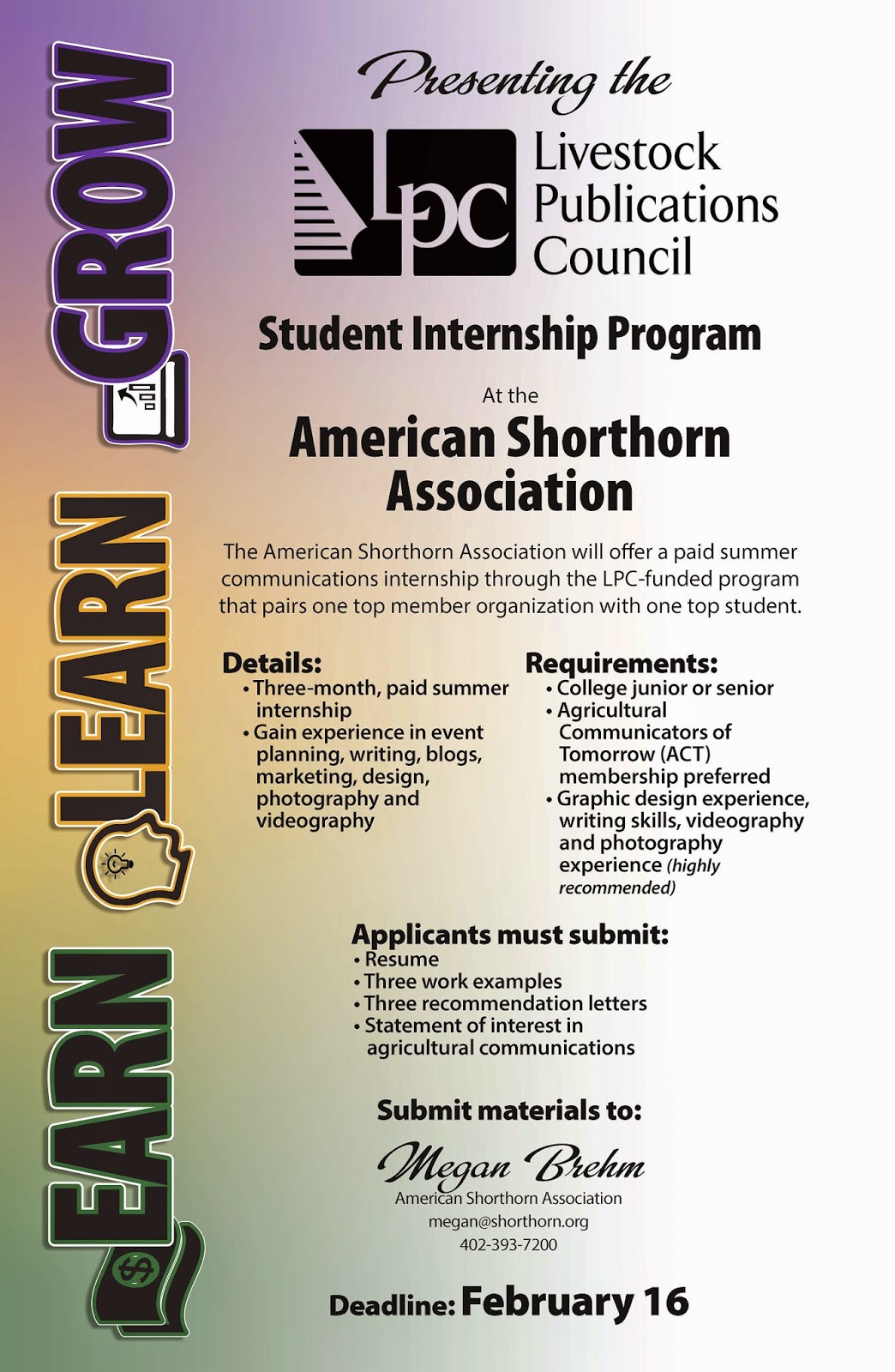
ASA to Host Livestock Publications Council Internship
The American Shorthorn Association is proud to announce that it has been selected to host the 2015 Livestock Publications Council summer intern. Members of the Livestock Publications Council were given the opportunity to submit applications for their respective organizations to host the intern. The ASA was selected from many qualified applicants.
This summer, the student will be given many opportunities to learn various functions throughout the organization. Primary goals of the internship will include marketing, photography/videography, design, and event planning.
For more information on this exciting opportunity, please contact Megan Brehm, Director of Communications and Marketing at the American Shorthorn Association.
Tuesday, November 11, 2014
Preparation is the Key to Success!
Today's blog post is from Theresa Sisung as we all prepare to head to Louisville!
As many cattle trailers are getting ready to hit the road and head out on their annual trek to Louisville, one of the most important things to remember before pulling out of the driveway is, preparation is the key to success.
We all know how it goes, or how it is suppose to go, if you work hard at home it will all pay off in the end. I do believe this, but when it comes to taking stock to a show there are other things that we tend to overlook that need to be done in order for all of our hard work to even matter. Like the ole saying goes "Success always comes when preparation meets opportunity"
Being properly prepared helps ensure success and that the trip goes off without a hitch. The first step to achieving this is sending in those entries. Clearly, if the entries aren’t done properly and turned in on time it won’t be possible to even take animals to the show. Going hand-in-hand with the entries are the registration papers. Once our entries are done I go through the registration book that we take to shows to make sure papers for the appropriate cattle are in there. I check and then double check that not only are cattle registered but that we have the ORIGINAL version of the papers with us when we pull out of the driveway with the trailer. Black and white photocopies or pages printed off an online registration system aren't going to cut it when it comes time to check in at the show. You'll be sadly disappointed at the response you'll get when you try and hand one of those to a breed representative checking in cattle.
Another thing that won't get you very far at the show is if your cattle aren't tattooed. Now I know no one likes getting that green tattoo ink on them or if you happen to have a white heifer, all over her, but you'll be far more disappointed if you can't show because you didn't tattoo your cattle. So, take the time ahead of time and tattoo your animals. If you even question whether or not yours are tattooed get out a rag and a flashlight and check it out for yourself. It is better to be safe than sorry.
The last critical preparation piece that basically determines whether or not your cattle can show or let alone be on the grounds are health papers. The vet is the go-to man that knows what we need and how to get it done. With that being said, make sure you look into this weeks prior to your departure as sometimes additional tests are needed. Regardless, your vet will appreciate you being ahead of the game and we all know we need to keep our vet on our good side.
Entries, registration papers, tattoos and health papers, they are all critical items that need to be taken care of prior to the show. Just like now days it's pretty hard to buy a drink or get on a plane without proper identification like a passport or drivers license, it is also pretty hard to show your cattle at a show without the proper paperwork.
If you've got all that stuff taken care of you shouldn't have to worry about not being able to show your animals. But one thing you do want to be able to do is not only show them off in the ring but also in the stalls. This is where preparing the proper signage is key. A good eye catching display can make your cattle and operation the talk of the barn. We try to accomplish this by having very readable signs for each animal that include our farm logo and any co-owners, then for the bulls we put on display we create larger eye-catching banners. Whatever you can do to create excitement about your cattle is helpful in promoting them and you.
Finally, once all of that stuff is prepared and taken care of there is only one more thing to do before hitting the road to the big show…PACKING. You have to pack for yourself and for your cattle. This is never a fun task and nine times out of ten it ends up in an argument but once that trailer door is shut and you're on the road to NAILE, it's all worth it. One of the best things to help make the packing process go smoothly is to make a list. Put together a list of everything you need ahead of time then just check stuff off as you pack it in the trailer. Heck I have even seen people who have this list and a diagram of how everything should be packed saved on their computer and before each show they just hit print and packing the trailer is a breeze.
I know a lot goes into getting ready for a show and this is just a scratch at the surface, but all things that can be easily over looked. So make sure you are prepared, that way you can enjoy standing on those green shavings and hearing the classic tune coming from the iconic organ man. Best of luck to all and safe travels on your journey to Louisville.
Monday, September 15, 2014
A Clear Focus at Clarmont Farm
By: Megan Brehm, Director of Communications and Marketing, American Shorthorn Association
I arrived a day early to the 2014 Shorthorn
Junior National Show in Louisville, Kentucky and made the drive to Maysville,
Kentucky. The trip proved to be a valuable experience: witnessing firsthand the
tremendous value Shorthorn cattle can bring to commercial cattle herds.
After one hundred
forty miles of picturesque country side driving from Louisville to Maysville
through the heart of Kentucky’s thoroughbred horse and bourbon country, I found
myself wrapped up in the natural beauty of the state’s winding roads, abundant
trees, and large open green pastures.
Nestled in the hills
of Northeastern Kentucky, Maysville is home of Clarmont Farm, a Shorthorn
influenced commercial herd operated by the Clarke family for over one hundred
years. After following winding roads and a few missed turns later, I arrived at
Clarmont Farm, a striking farm with rolling pastures and ponds.
Approximately one hundred and twenty Shorthorn/Angus
influenced cows make their home at Clarmont. The herd is based strictly on
performance traits in growth, terminal carcass traits, and profitability. The
herd calves in both spring and summer with approximately a quarter of calving
completed in the fall months.
Clarmont Farm has been operated by the Clarke family in
continuous succession for over one hundred years. The operation began in 1913
with row crops, hay, and cattle. In the early days of the farm, all cattle were
purebred Shorthorn seedstock. Reese Clarke, founder of Clarmont Farm, bought
and sold cattle over a large region spanning from Canada south. Since then,
many changes have occurred at the farm, but one constant remains, a love for
high quality cattle. Today, the farm is operated by Craig & Janet Clarke
and Tyler & Kenzie Clarke. Tyler is the fourth generation family member to
raise cattle at the farm. Jeff Jones, Farm Manager, is also credited with much
of the farm’s success. Jones is a natural cattle enthusiast with a heart for
the farm, second to none.
Beginning in the 1980’s the focus of the farm shifted from a
purebred Shorthorn operation to an Angus commercial program with some Shorthorn
influence. Over the years, the Clarke’s noticed that performance quality had
gradually been decreasing. It was time for a change. In effort to increase
performance within the herd, attention shifted back to the Shorthorn breed. The
Clarke’s needed a crossbreeding tool to increase maternal and carcass traits.
Shorthorns were the solution. “We simply looked at Shorthorns as the quickest way to improve our
cattle herd; particularly in regards to growth and birth weights,”
stated Tyler Clarke. “I spent a tremendous amount of time researching how we
could build in many of the performance traits we needed to return to our herd.
Shorthorns easily made their way to the top for crossbreeding potential.”
Clarmont Farm’s herd is comprised of nearly all Angus/Angus
cross cows. All cows at the farm are selected for carcass and maternal traits. All
bulls at Clarmont are now Shorthorn; they must meet rigid standards for
quality. Any bull selected for use in their operation must be backed by heavy
duty performance data. The end goal for the Clarmont operation is terminal
beef; genetic decisions must be made that are reflective of that goal. Bulls are
selected to be in the top 1% of Weaning Weight and Yearling Weight EPD’s for
the breed, along with a solid maternal genetic background. Bulls have primarily
been purchased from the Waukaru herd, Rensselear, Indiana. Bulls from Waukaru
have been predictable in their genetic output, largely due to the tremendous
amount of performance data collected from their herd. Bulls have been
consistent and pass on real world performance attributes that improve the
Clarke’s bottom line.
The results? The Shorthorn/Angus cross calves have easily
outperformed their straight Angus calves from years before. The crossbred Shorthorn/Angus
calves have been quite versatile, recording higher weaning weights and high
meat quality. “We are extremely pleased at how well the Shorthorn cattle have
adjusted to their surroundings and thrived. They have adapted well to drought
and rough winters with ease, all while keeping their high quality maternal
traits. Our goal is to produce high quality consumer focused beef. Shorthorns have been up to the
task and have improved our end product dramatically.”
Evidence of the quality the Shorthorn breed can bring to
commercial cattle herds is clearly visible through the results obtained at
Clarmont Farm. The Clarke’s are able to offer a new and different perspective
for purebred Shorthorn breeders as a customer of the breed. What could
Shorthorn do better? What direction should breeders aim towards in the future?
Tyler Clarke believes the answer lies primarily in promotion and education.
“The Shorthorn breed must establish a presence within the commercial beef
industry as a proven, quality, answer for crossbreeding and herd improvement.
As an association, effort needs to be directed towards supporting the
commercial segment of the industry who purchase Shorthorn genetics. The
ShorthornPlus program has a tremendous product, but customers must be made
aware of the value and performance associated with adding Shorthorn influence
to their herd.” With continued interest in the Shorthorn breed, the concept
will continue to expand, but efforts to grow will expedite the growth. Examples
of areas Clarke believes could make a difference include establishment of a
database of supply chain for Shorthorn genetics and mass marketing of Shorthorn
influenced stockers.
Overall, the Clarke’s are extremely satisfied with the impact
Shorthorn cattle have made on their herd. As commercial breeders, the added
value to their calves has been dramatic. Since reincorporating Shorthorns back
into their genetic lineup, the Clarke’s haven’t’ looked back. As I made the
return trip to Louisville, my thoughts shifted from the scenery around me to
the road the Shorthorn breed is travelling. Shorthorn and ShorthornPlus
composite cattle have a bright future in store. “The future is bright for the
Shorthorn breed, we couldn’t be more enthusiastic to utilize all Shorthorn has
to offer,” stated Clarke.
Monday, July 14, 2014
Prior Planning Prevents Poor Performance
“Remember, prior planning prevents poor performance.” These
were the words of a wise college accounting professor I was given the opportunity
to learn many things from. At the beginning of the course’s first semester, I
comprehended the scope of the quote to apply only to class materials and the importance
of studying for exams. However, as the year progressed, I began to understand that
the concept of prior planning encompassed far more than my accounting homework.
Today, as I continue to think about the significance of this
saying, its importance in the cattle business becomes clear. So oftentimes, in the hectic nature of our
day to day activities at a cattle operation, future planning becomes tossed
aside in lieu of more pressing tasks at hand. However, to ensure our future
success, planning for the future is of utmost importance.
Do you know where you want your operation to be in the
future? Today is the best day to set goals for tomorrow. Be proactive in making
your operation even better than it is now. Learn more about a topic that could
help improve your bottom line, try a new idea, the opportunities are endless.
Today’s beef cattle market is the highest on record. How can you plan ahead to
make sure your operation is profitable when markets become narrow?
·
Establish
an effective record keeping system. Incorporating a system that accurately records
expenses and profits will be a valuable decision making tool. Decisions can be
made with real world numbers, in turn helping to increase productivity and
profitability. Are your cattle
performance records up to date? Do you have a performance record keeping system
in place? If not, take the time to learn more about record keeping and to find
a system that best meets your herd’s needs.
·
Gain
knowledge about industry trends and technology. Today’s fast paced, technology based world
has not overlooked the cattle industry. Today, there are many products,
innovations, and technology available that can help your herd and operation
improve. Areas that technology continues to touch include: reproductive, feed
efficiency, and herd health technology.
Oftentimes, looking to the future can be overwhelming;
however, the task today will reap benefits over and over in tomorrow’s world. Agricultural
producers have a multitude of resources available to help answer questions and
provide educational materials. State extension services are a great place for producers
looking for useful information. As you transition and prepare for the future, I
hope you too will remember that “prior planning prevents poor performance.”
Monday, June 23, 2014
What Can Performance Data Do for You?
With added emphasis being place on today’s cattle producers
to utilize performance data within their operations, many may be left wondering
what the benefits will be. Sometimes as a small breeder it is easy to ask “what
does my data really matter, if any, besides-I only want to register a few head
this year.”
Performance should matter to all breeders; no matter how big
or how small. Performance data relies on the submission of data from all
breeders and cattle. When considering how EPD’s work, all data is averaged to
give indicators of genetic performance. When only cattle to be registered have
data submitted, it skews the accuracy of all EPD’s. The concept is simple; we need all the data
we can get for the most accurate EPD’s possible.
Some beneficial thoughts about submitting and utilizing
performance data:
- EPD's are a common sense approach to competing with other breeds in a factual, easy to compare manner. When the ASA completes its transition to the Multi-Breed EPD system, breeders will receive EPD’s that compare to the largest genetic evaluation system in the industry.
- Improved marketing opportunities will result for cattle with EPD data to back their genetics. Cattle that are proven with accurate EPD results will be more appealing to customers who want to keep performance in check.
- The breed will experience long term improvement through better data records. Performance records take the effort of all breeders submitting data for the good of the whole breed to be of great use.
The Shorthorn breed has a decision to make as the ASA
transitions to the Multi-breed EPD evaluation system. Will the Shorthorn breed utilize performance data to its full potential? Please take time to
consider the impact your herd’s data can play in the enhancement of the whole
breed.
Monday, June 2, 2014
Building a Better Future
With summer comes the process of moving cattle to pasture,
AI breeding, and administering vaccinations. As producers are hard at work with
such activities, it is a great time to evaluate practices and facilities for
possible areas to improve handling of cattle.
The movement for animal welfare and safe handling processes
has increased dramatically in past years. Numerous food retail outlets have
incorporated animal handling requirements before products are purchased from
suppliers. Consumers want to be reassured they are receiving a safe, wholesome
meat product that was handled appropriately. As producers, keeping ahead of the
trend will not only make for more efficient use of time when working or moving
cattle, but will help the beef industry gain credibility and trust from beef
consumers.
![]() |
The first step to assuring quality in our beef products is
to carefully evaluate methods that are in practice at our operations now. Look
for areas that need to be improved. Examples include improving working
facilities that are lower-stress for animals, taking note to not overcrowd
animals, or improving lighting in working facilities for a safer environment.
Evaluating the method in which cattle are worked is an important step for
cattlemen to take. Programs such as Beef Quality Assurance (BQA) are ways to
improve knowledge of appropriate handling of cattle. Sharing BQA information
with employees or others involved in the direct management and care of cattle
allows everyone involved in the operation to handle cattle safely and
contribute to overall success.
| Consumers are more concerned than ever about the quality of meat products we provide. |
Members of the American Shorthorn Association have a unique
opportunity to position themselves as leaders in the beef industry by taking
beef quality assurance and safe handling techniques seriously. Image the impact
that the breed could have in the future with 50%, 80%, or 90% of our membership
certified in BQA. Today’s consumers are demanding their food is safe and
properly handled. By spreading the message that more beef producers, are
determined to meet and exceed consumer demands, we will build confidence and
demand for our product. Marketing efforts in today’s world could make a
dramatic difference in demand for Shorthorn beef if our membership base was
viewed as a group of cattlemen concerned about the quality of product and the
consumer who purchases it. There is no time better than the present to prepare
and pave the way for a bright prosperous future.
Thursday, May 22, 2014
Are You Ready for Summer?
Memorial Day is this weekend! With the holiday's arrival, marks the unofficial start of summer. As summer arrives, focus should shift towards herd maintenance issues. Taking the time to prep for herd health concerns will ensure a healthy cow herd through the duration of the hot, stressful summer months for cattle.
Some tips for cattle management throughout the summer months are:
- Water
- Provide constant fresh water source for cattle on pasture. Cattle require more water during the summer months than one may realize. Consider the minimum requirements for cattle at 90F.
- 400 lb Calves: 9.5 gallons/min per day
- Lactating Cows: 16.2 gallons/min per day
- Mature Bulls: 20 gallons/min per day
- Mineral Program
- Cattle should continue to receive a high quality mineral supplement while on summer pastures. Consider the demands of hot weather, terrain, and lactation on cows; supplement accordingly for increased conception rates and herd heath.
- Fly Control
- With summer, comes the return of flies. Flies are a major nuisance for cattle and producers. Flies are able to spread pink eye and mastitis through the herd, as well as increase herd stress. Consider multiple options when seeking to control fly population. Methods that make a difference include fly control mineral supplements, fly tags, insecticide dispensing rubs for cattle, among others. Evaluate the needs of your herd for the most effective program to suit your needs.
From everyone at the American Shorthorn Association, enjoy your holiday weekend!
Subscribe to:
Posts (Atom)